Le documentariste Sooyong Park a
passé cinq années, seul, dans les forêts de Russie pour tenter de
filmer le tigre de Sibérie dans son environnement naturel.
De toutes petites fourmis originaires d'Argentine ont commencé à
coloniser à grande échelle les rives européennes de la Méditerranée.
Leur communauté s'est déployée sur près de 6000 kilomètres, du Nord de
l'Italie au Portugal, en passant par la France et l'Espagne. Ces
milliards d'insectes forment ainsi une structure organique géante qui
n'a pas son pareil à l'échelle de la planète. Des chercheurs étudient
leurs stratégies prédatrices au détriment des espèces de fourmis locales
et leur capacité à modifier les écosystèmes. Est-il possible d'enrayer
leur progression vers le nord ? Les scientifiques en doutent fort.
http://videos.arte.tv - Documentaire de François de Riberolles - Année : 2012 - Durée : 1h23mn - Origine : France - Coproduction : ARTE France, Saint Thomas - Productions : Entre chien et loup
- Raconté par : Jacques Gamblin - STREAM : V.F , V.F - DL : V.F , V.F
Les volcans sont à l'origine de cataclysmes qui ont bouleversé la vie
sur notre planète. Ils sont aussi l'un des moteurs essentiels de
l'évolution des espèces. En racontant la vie de l'un deux, sur plus de
60 millions d'années, ce documentaire nous fait vivre les évolutions
majeures qu'ils ont fait connaître aux plantes, aux animaux et aux
hommes. Ils furent tour à tour bourreaux des dinosaures, refuges des
créatures marines ou paradis fertile pour l'espèce humaine.
Il aura
fallu cinq années de tournage auprès de plus d'une trentaine de volcans
actifs, à travers l'océan Indien, pour retracer l'odyssée du "point
chaud" (anomalie de l'écorce terrestre par où s'échappent régulièrement
des laves volcaniques) qui se trouve à l'origine de l'île de la Réunion.
Pour que ce voyage dans l'espace et le temps reste mémorable, les
équipes de Saint Thomas Productions ont recréé des dinosaures en images
de synthèse de très grande qualité, immergé des sous-marins dans des
mondes oubliés et adapté le dernier cri de l'imagerie haute définition à
leur sujet dangereux car imprévisible.
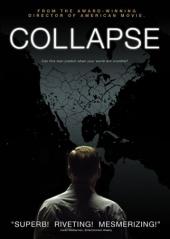
Collapse, directed by Chris Smith, is an American documentary film exploring the theories, writings and life story of controversial author Michael Ruppert. Collapse premiered at the Toronto International Film Festival in September 2009 to positive reviews.
Ruppert, a former Los Angeles police officer who describes himself as an investigative reporter and radical thinker, has authored books on the events of the September 11 attacks and of energy issues. His detractors[who?] call him a conspiracy theorist and an alarmist.
Director Smith interviewed Ruppert over the course of fourteen hours in an interrogation-like setting in an abandoned warehouse basement meat locker near downtown Los Angeles. Ruppert’s interview was shot over five days throughout March and April of 2009. The filmmakers distilled these interviews down to this 82 minute monologue with archival footage interspersed as illustration.
The title refers to Ruppert’s belief that unsustainable energy and financial policies have led to an ongoing collapse of modern industrial civilization.
The film does not overtly take a perspective on the validity of Ruppert’s positions and critics have alternatively described the film as supportive and as critical of Ruppert’s views. Smith himself, speaking at the Toronto International Film Festival premiere, said that "What I hoped to reveal was ... that his obsession with the collapse of industrial civilization has led to the collapse of his life. In the end, it is a character study about his obsession." [1]
Sitting in a room that looks like a bunker, Ruppert briefly recounts his life including his parents' ties to U.S. intelligence agencies and Ruppert’s own career as an LAPD beat cop and detective. Ruppert then summarizes current energy and economic issues, focusing mainly around the core concepts of peak oil and sustainable development. He also criticizes fiat money and discusses CIA drug trafficking.
The bulk of the film presents Ruppert making an array of predictions including social unrest, violence, population dislocation and governmental collapses in the United States and throughout the world. He draws on the same news reports and data available to any Internet user, but he applies a unique interpretation -- “connecting the dots” as he calls it.
Smith periodically stops Ruppert to question his assumptions and provide a note of skepticism.
Critical reception
After its premiere at the Toronto Film Festival, Owen Gleiberman of Entertainment Weekly called Collapse “one of the few true buzz films of the festival” and wrote that “you may want to dispute (Ruppert), but more than that you’ll want to hear him, because what he says — right or wrong, prophecy or paranoia — takes up residence in your mind.” [2] Daily Variety wrote that Collapse was “unnervingly persuasive much of the time, and merely riveting when it's not, Ruppert's talking-head analysis gets the Errol Morris treatment from director Chris Smith (American Movie), whose intellectual horror film ranks as another essential work.” [3] The Onion’s AV Club wrote that “in several immensely poignant moments, we can also see an angry, lonely, vulnerable man whose life epitomizes the title as much as the globe does. There are many layers to the man and the movie, and I for one left the theater shaken.” [4] Roger Ebert wrote, "I don't know when I've seen a thriller more frightening. I couldn't tear my eyes from the screen. "Collapse" is even entertaining, in a macabre sense. I think you owe it to yourself to see it." [5]
Distribution
In October 2009 the filmmakers announced that Collapse would premiere simultaneously in theaters in New York and on Video On Demand on November 6, 2009. [6] According to press announcements, this unique release arrangement “will mark the first time a film will be released this soon after it premiered at a festival without distribution.”
Il est adapté du livre éponyme Le Syndrome du Titanic où Nicolas Hulot développe les thèmes qui lui sont chers, autour de l'évolution de l'environnement et de l'érosion de la biodiversité.